Parish Notes Durham
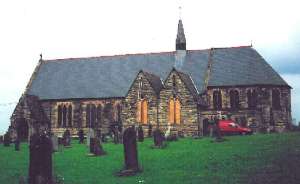
Newbottle St Matthew
[Population 1911: 4,948]
Parish Notes Durham
[Population 1911: 4,948]
| The Parish Church Townships Topography History Its Records The Parish Chest Non-Parochial Records Monumental Inscriptions Indexes |
|
The Village of Newbottle is pleasantly situated on an eminence, about one-and-a-half mile north of Houghton-le-Spring, and commands a good view of the adjacent country. Here is a chapel-of-ease to the parish church, a small but neat building, in the early English style, consisting of chancel, nave, and south transept. The windows are of stained glass; those in the chancel bearing representations of the Crucifixion, St. Michael, St. Matthew, &c. It was opened for service in October 1851, and consecrated by the Bishop of Durham on the 7th August, 1851. The ground for the chapel and burial ground was given by the Earl of Durham, who also subscribed liberally towards the building. The living is a curacy in the patronage of the rector of Houghton-le-Spring, and incumbency of the Rev. George Snowden. [Whellan's History, Topography and Directory of Durham (and Newcastle) (1856), pages 633-34.]
| Top of page |
| Top of page |
| Top of page |
Gateshead Observer 2/11/1850 NEWBOTTLE CHURCH.- A new church was opened on Monday last, at Newbottle, in the parish of Houghton-le-Spring. The Rev. C. Freeman read prayers on the occasion, assisted by the Hon. and Rev. Francis Grey, Rector of Morpeth; and the sermon was preached by the Hon. and Rev. John Grey; after which the holy communion was administered to a large number of persons. The clergy and choir walked in procession to the church, chanting the psalms. The church is built upon ground contributed by the Earl of Durham, who was also a large contributor to the building fund, in commemoration of his inheriting his estates. The church, which was built by subscription, is a very neat edifice, in the Early English style of architecture.
| Top of page |
| Top of page |
Durham Advertiser 22/6/1832 The boiler of the Philadelphia steam engine, belonging to Lord Durham, situate near Newbottle, burst last Friday morning about seven o'clock. The explosion was dreadful; and it is supposd that at least 500 tons weight of machinery, buildings, &c. were removed by its force. Adjoining the engine was a dwelling-house for one of the workmen, part of the house was forced in, and Joseph Sheldon and his three grand children, Joseph, Mary Ann, and Elizabeth, two of whom were in bed at the time, were buried under the ruins. The old man was heard to speak; but, before the materials could be removed he died, as also the three children. The mother of the children had her arm broken. About a yard from the boiler which burst were four men employed in repairing another boiler. Three of them were inside, and the other was under it caulking the bottom. This boiler, by the force of the explosion with the three men - John Hall, Thomas Kirkup, and Ralph Walton - who were inside, was thrown a distance of at least thirty yards, and Robert Soulsby, who we have mentioned as being under it was also found in that situation after it had been so removed. John Hall died immediately, but the others lingered till the Monday following totally insensible - when death terminated their sufferings.- They had each received a severe concussion of the brain and were otherwise much injured and bruised. A man of the name of Christopher Johnson was very much burnt and scalded. He is still alive but little hopes are entertained of his recovery - others were also injured. Inquests were held upon the bodies on Friday and Tuesday; and after a patient investigation the Jury returned a verdict of accidental death in each case.
| Top of page |
| Top of page |
© 1999-2005 Original Indexes